I will explain how these animals, evolved/naturally selected, their unique characteristics that make them living, and finally I will share any questions I had about the various animals
Roundworm (phylum nematoda)
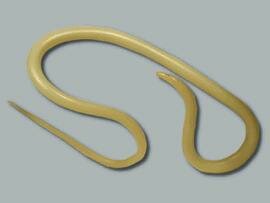
-Evolution/Natural Selection-
The roundworm is thought to have evolved from the flatworm. Roundworms evolved to inherit a circulatory system, as well as the ability to not only live in the ocean, but on land, people, and even plants. They also have a complete digestive system as well as a nervous system, over their ancestors.
-Requirements and Characteristics-
The roundworm has some interesting characters, however there are few. The roundworm is motile, but in can only dramatically squirm around almost in an, "S", formation. This method of transportation, however, doesn't cover a long distance at all. Other features like the roundworms digestive system, its nervous system, and its non-violent way of reproduction all contribute to the roundworms way of living.
-Being Curious and Asking Questions-
One question I have is why do roundworms move in that dramatic way? How did it help the roundworm become selected over other evolutions of the flatworm? Does it not take a lot of energy to go through these almost seizure-like actions?
Earthworm (phylum annelida)

-Evolution/Natural Selection-
The earthworm is known to have evolved from the roundworm. The earthworm has a segmented body. Remarkably, each segment is almost an exact replica of one another, each containing the same muscles, excretory, nervous systems. Each segment is also considered to be an independent animal. It is a well-known fact that earthworms are good for gardens due to their ability to digest harsh amounts of metals in the soil, which help plants grow, but did you know they had to evolve to make it happen. Numerous amounts of earthworms died to extreme conditions of the polluted soil, however, the species that could tolerate the harsh environment, thus became selected for.
-Requirements and Characteristics-
The earthworms main characteristic would be its ability to regenerate from detached segment. If you were to cut and earthworm in half, the earthworm would then become to separate animals. Earthworms digestive system is similar to that of the roundworms, but is more complex in the fact that the earthworms has gizzards to grind up the food for excretion. They have hearts in each segment that helps transport blood throughout the animal, as well as a closed circulation system.
-Being Curious and Asking Questions-
What event caused the roundworm to evolve causing it to form a segmented body?
Why are there so many species of earthworms around the world?
Did earthworms evolve into arthropods? If so what caused them to need to change?
Grasshopper (phylum arthropoda)

-Evolution/Natural Selection-
The grasshopper has been around for an exceptionally long time. The are said to have been present since triassic times, due to the fossils found and some being encased in amber. The grasshoppers hind legs is a huge factor in how the grasshopper has been successful. Although grasshoppers and locusts are known to be different, they are the same species. Their ability to decimate crops in swarms and their ability to fly are another two reasons the locust/grasshopper has been around since biblical times.
-Requirements and Characteristics-
The grasshopper has mandibles for chewing up the various plants and crops it digests. Grasshoppers also have spiracles on their abdomen which act as,"Breathing holes," to aid in respiration. Grasshoppers are notoriously renowned jumpers which greatly aid them in escaping predators as well as quickly searching for more food. The grasshopper also was the first animal to exhibit an exoskeleton. The grasshoppers open circulation system and their sound sensing nervous system greatly aid them in finding mates.
-Being Curious and Asking Questions-
Grasshoppers = Locusts, what?
Apparently irritating a grasshopper transforms them into locusts, is this true?
How come grasshoppers depend more on their legs, while locusts are primarily known to fly?
Starfish (phylum echinodermata)

-Evolution/Natural Selection-
Starfish comes from an almost standalone phylum, so it's difficult to determine what it evolved from or how it came to be.
-Requirements and Characteristics-
The starfish is a complex organism compared to the above animals that I have dissected. It has an internal skeleton. The starfish digests food by squirting digestive enzymes on its prey, and then proceeding to suck the prey inside of its mouth, which leads to its complete digestive system. Its digestive system consists of a small esophagus called an oesophagus which leads into its two stomachs, and its aboral anus. The starfish also has eyes on each of its radial arms.
-Being Curious and Asking Questions-
How come some starfish have more than 5 arms? How does this benefit it?
Do all starfish digest its prey the same way? Can some just simply eat their food?Grass Frog (phylum vertebrata, class amphibia).
http://moeizebio11.blogspot.ca/2014/01/frog-dissection.html

-Evolution/Natural Selection-
Frogs have evolved in countless ways. Some live in trees, jungles, grass, and even water. Frogs have been found to have evolved from lobe-finned fish or bony fish, similarly to other amphibians. Frogs have numerous characteristics that helped the various species become successful. Some characteristics that a good majority of common frogs share is their incredible hindlegs. Like the grasshopper frogs have inherited a powerful hind leg that can propel the frog to great distances as well as heights. Frogs also have a way of communicating known around the world as ,"croaking." Finally, frogs have an almost elastic stretchy tongue that aids them in snatching up their invertebrate prey.
-Requirements and Characteristics-
Frogs have a digestive system strikingly similar to that of humans. It works the same way as ours too. Frogs are known to reproduce via laying eggs in water, since their offspring can only swim. Some frogs transfer sperm to their mate through a process known as amplexus. Frogs also have a closed circulation system consisting of lungs, a heart and many blood vessels. Frogs also have an internal skeleton as well as a nervous system also similar to humans, they too have brains.
 |
| Frogs transferring sperm the amplexus way |
-Being Curious and Asking Questions-
What caused the lobe-finned fish the need to grow legs and live on the land?
Whats the difference between frogs and toads?


